If you’re into coding, engineering and futuristic tech, robotics is one of the hottest pathways to explore
Written by Smriti Daniels, author of Robot Responders
Robotics is absolutely booming in Australia right now. Mining, defence, agriculture, warehouses, healthcare and even space tech are all hiring robotics engineers fast.
If you’ve seen the news, you might have got the message about Australia’s national productivity slowdown. It’s a problem. Basically, we need smarter ways to get more done, and that’s where robotics and automation come in.
The Australian government is focusing on new tech because robots, AI and automated systems could add an extra $170–$600 billion to Australia’s economy every year by 2030. Translation? Huge demand for people who can build, program and run this tech.
What’s hot in Aussie robotics
Field robots
Built for tough environments, these robots can be found around mines, bushfires, the deep sea, even on the Moon.
Wearable robots
A University of Queensland team is trialling a robotic exoskeleton for people living with motor neuron disease – a world-first MND trial.
Conservation robots
These bots are monitoring the Great Barrier Reef and helping grow new corals to replace bleached ones.
Get started now!
- Join your school’s robotics club, or start one
- Enter RoboCup Junior Australia or FIRST Robotics
- Build something with a Raspberry Pi, Arduino or micro:bit
Kung fu robots
The one thing we didn’t have on our 2026 bingo card? Humanoid robots performing kung fu live on Chinese national TV, complete with swords, poles and nunchucks.
The clip from this year’s Spring Festival Gala in Beijing went viral worldwide – even making headlines in Australia!
The Ds of robotics
Dirty – Dangerous – Dull – Disasters – Discovery – Dancing
Roboticists like to talk about jobs that are too dirty, dangerous or dull for humans. Think: cleaning toxic waste, checking the inside of nuclear reactors or scrubbing the outside of skyscrapers. This is work we’d rather hand to robots!
Add disasters (finding survivors in collapsed buildings) and discovery (exploring Mars, the deep ocean floor or volcanoes), and you’ve covered most of what robots are for.
And of course, let’s not forget dancing. Half showmanship, half stress test for the hardware, and as useful as it is fun.
Out-of-this-world engineering
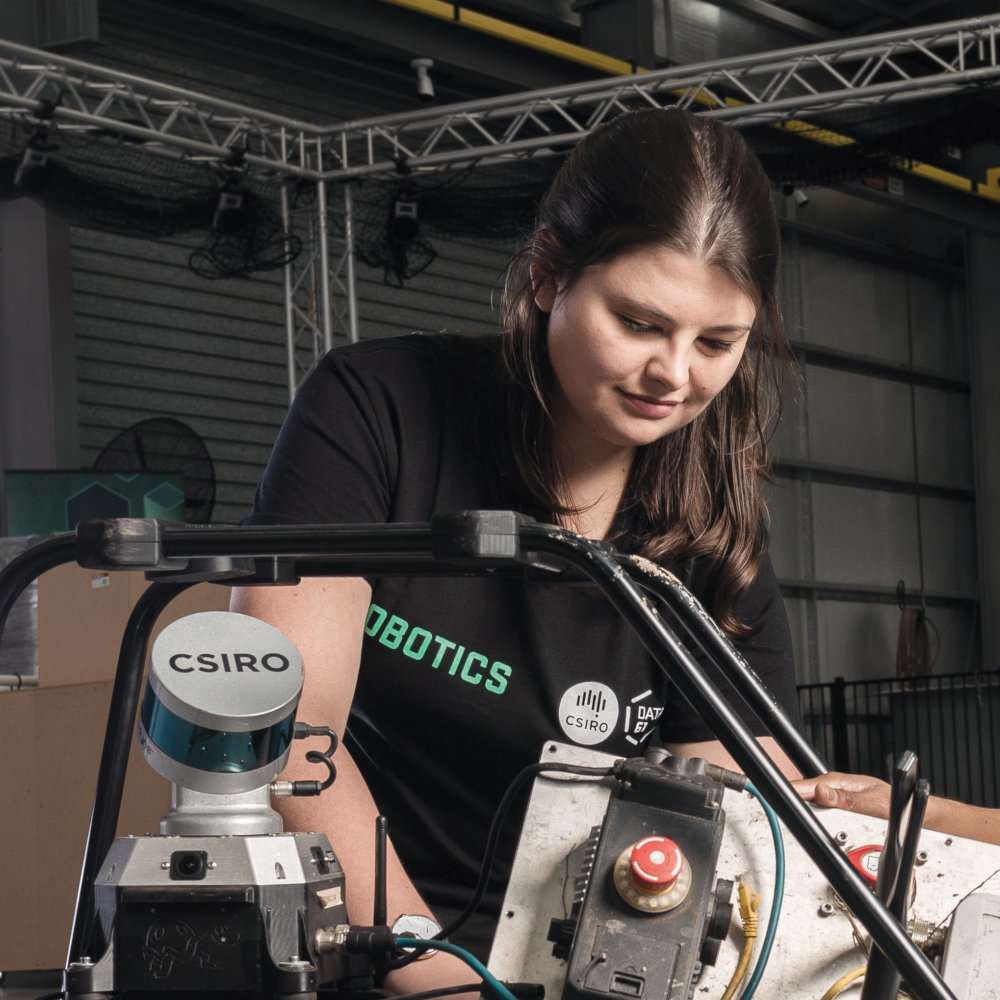
Lauren Hanson designs robots for space – and her workshop reaches all the way to the International Space Station.
As a kid, Lauren loved LEGO and pulling things apart to see how they worked. Now she’s a senior mechanical engineer at CSIRO, Australia’s national science agency, and her latest collaborator orbits 400km above Earth.
Astrobee is a trio of cube-shaped robots that float through the International Space Station on fans, helping astronauts with research and routine tasks. Next up: robots to mind NASA’s planned Lunar Gateway when no humans are on board.
Designing for space means dodging flammable materials, brutal temperature swings and zero gravity. It also means failing – a lot.
“If you’re not failing, you’re not learning. Sometimes you learn more from failure than you do from success,” Lauren says.
Career path
- Bachelor of Science, Monash University
- Bachelor of Mechanical Engineering (Honours), Monash University
- Project lead, Nova Rover
- Mechanical engineer, Gilmour Space Technologies
- Robotic design team lead, CSIRO’s Data61
- Senior mechanical engineer, CSIRO’s Data61
Start your career here
Engineering + robotics + study
- Advanced Diploma of Engineering (Mechanical), TAFE NSW
- Bachelor of Engineering (Honours) (Robotics and Mechatronics), Monash University
- Bachelor of Engineering (Honours) (Mechanical and Mechatronic), UTS
- Master of Robotics and Artificial Intelligence, QUT
Engineering + robotics + jobs
- Robotics engineer $50K–$101K
- Automation engineer $62K–$133K
- Mechatronics engineer $62K–$126K
- Software engineer $65K–$131K
*Salaries according to payscale.com
This article first appeared in Careers with STEM: Engineering 2026.