So you want to be a nurse, or maybe you’re already on your way to becoming one and want to find out what you could specialise in?
Below, we cover three different types of nursing, specific areas you could work in, and the pathways you can take to land your dream gig in this popular area of STEM.
What is a nurse?
According to the World Health Organization, nursing encompasses autonomous and collaborative care of individuals of all ages, families, groups and communities, sick or well and in all settings. It includes the promotion of health, the prevention of illness, and the care of ill, disabled and dying people.
Give me some nursing facts…
Okay, okay! Here’s what you need to know about your future career in nursing:
- There are around 450,000 registered nurses and midwives in Australia, making it the largest clinical workforce in the country.
- The National Skills Commission has identified the top 10 jobs that are projected to grow by 2025 and coming in second is… registered nurse!
- Globally, an additional nine million nurses and midwives are needed by 2030.
All this means is that it’s a really good time to become a nurse because your employability will be high!
Types of nursing
There are three main types of nurses:
Enrolled nurse: to become an enrolled nurse, you need to completing a Diploma of Nursing through a VET provider. Once on the job, an enrolled nurse’s duties include things like monitoring patients and recording temperature, pulse and blood pressure, administering medicine, and helping patients with general daily living activities. They work with the wider health team and under the supervision of a registered nurse.
Registered nurse: a registered nurse has a Bachelor of Nursing or a Master of Nursing, and has a wider scope than an enrolled nurse. Their duties can include assessing patients, creating care plans, supervising enrolled nurses and junior team members, and working in leadership positions.
Nurse practitioner: a nurse practitioner is a registered nurse that has been endorsed by the Nursing and Midwifery Board of Australia. According to the Department of Health Care and Aged Care, they practise independently in an advanced and extended clinical role, and can prescribe some medicines.
You can read more about these types of nursing on the Department of Health Care and Aged care site.
What about midwives?
Midwives are professionals trained to support and care for people during pregnancy, labour and birth. To become a midwife, you need to complete a Bachelor of Midwifery. Or, if you’re already a registered nurse, you can complete postgraduate studies in midwifery.
RELATED: Download our FREE Postgraduate Course Guide: Nursing
Nursing specialities
There are a variety of different areas of nursing you can get into. We’ve listed some popular nursing specialities below.
- Aged care
- Cardiology
- Dialysis
- Emergency
- Family health
- Intensive care
- Mental health
- Oncology
- Paediatric
- Rehabilitation
RELATED: Quiz – Discover your nursing niche and the postgrad course for you
Where do nurses work?
Hospitals (both public and private), of course, but also other places in the community. These include:
- Aged care faciltiies
- Schools
- Medical centres
- Correctional facilities
- Rural and remote communities
- Community health services
- Aboriginal Community Controlled Health Services
How well does it pay?
Nurses in Australia can earn as much as $250,000 a year, depending on their speciality. Here’s a handy guide to the highest paid nursing jobs in Australia.
The STEM in nursing
Nurses use maths on the daily to care for patients. Think arithmetic for IV and medication calculations, metric conversions and decimals when dealing with weight, fractions, ratios, rounding and unit conversations for administering medication dosages, and percentages for giving oxygen.
Other important skills need in different types of nursing
Communication, teamwork, empathy, problem solving, analytical thinking and leadership are core skills you’ll need to be a great nurse!
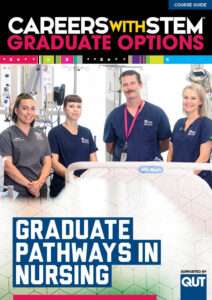
To find out more about pathways into nursing and study options, check out our Graduate Pathways to Nursing guide, delivered in partnership with QUT. It’s filled stories from current nurses, career options and reasons why you should consider this in-demand profession.
Keep up-to-date on Graduate Options by subscribing to the Careers with STEM e-newsletter!