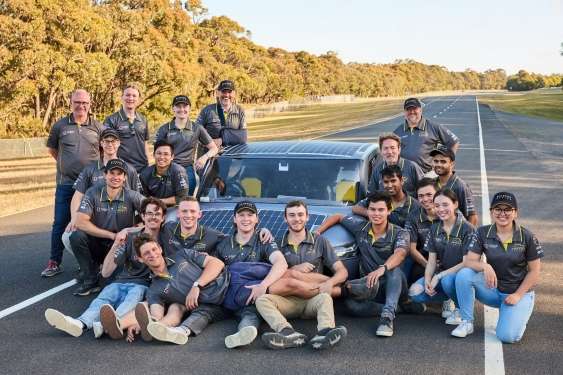
A group of UNSW students are challenging the way we think about solar cars after building the incredible Sunswift 7 and setting an unofficial Guinness World Record
The idea of accessible, solar-powered cars are the dream, right? And thanks to a real-world STEM project out of UNSW, they could become a reality even sooner than we think.
This week UNSW students have set a new unofficial Guinness World Record for the fastest electric vehicle (EV) over 1000km on a single charge.
The Sunswift 7, a solar-powered car built by the students, averaged almost 85km/h for over 11 hours and 53 minutes, covering 1000km in total.
“It feels very weird to think that we’ve helped to make something that’s the best in the entire world,” said Sunswift Team Manager Andrea Holden, a Mechanical Engineering student at UNSW.
“It’s been so rewarding to see the whole team come together and make so much progress and get us to this amazing point. It was a lot of work and a lot of hours and a lot of stress, but it’s all been worth it. This world record is validation of all the effort everyone in the team has put in.”
The Sunswift 7 is the latest in a series of successful solar-powered cars produced by UNSW since 1996. It weighs just 500kg, around a quarter of the weight of a Tesla, and is highly efficient thanks to its aerodynamic design, efficient motors and drive chain, and low rolling resistance.
A bump in the road
The record attempt wasn’t without drama, with a battery management issue causing the car to come to a complete stop at one point. The rules of the event stated that the Sunswift 7 couldn’t be stationary for more than 15 minutes at a time, and it took the team 14 minutes and 52 seconds to fix the problem and get back onto the track.
“This is amazing, incredible. Wow. The whole year has been leading to this point and it hasn’t been plain sailing,” said Professor Craig Hopkins, who heads up operations for the Sunswift Racing team.
“To be honest, we had our doubts whether we were going to be able to achieve it. So to come here and do what we set out to do is just the most incredible feeling. I’m sure those sentiments are shared amongst the whole team.”
The Sunswift 7 completed 240 laps of the Australian Automotive Research Centre’s Highway Circuit, the equivalent of driving from Sydney to Melbourne. It stopped only to allow for a change of driver every few hours and to change a tyre due to a puncture, as well as to fix the battery management issue.
“Let’s remember, these are not the best-paid professional car makers in Stuttgart working for Mercedes. This is a bunch of very smart amateurs who have taken all the ingredients and put it together in a brilliant way,” said Professor Hopkins.
“These young men and women are the future and they have already demonstrated here with Sunswift what they are capable of – imagine what they will do when we let them loose on the wider world.”
This news is exciting for anyone interested in a career in engineering, as it shows the incredible things that can be achieved by a team of dedicated students. Working on projects like the Sunswift 7 can give young people valuable experience and skills that they can use to pursue a rewarding career in this field.
It’s also a great example of the potential of renewable energy and the role that engineers can play in developing and implementing new technologies to reduce our reliance on fossil fuels.
Keen on maths and physics? A degree in renewable energy engineering could be for you! UNSW SPREE are inviting interested students to check out their solar engineering facilities. Email [email protected] (‘lab tour request’ as subject) to express your interest.
READ MORE: