From wearable sensors to quantum imaging, STEM can save lives
– By Mike McRae
It’s been a little over two centuries since the first recorded use of a stethoscope. In 1816, the French physician René Laënnec used a simple tube to listen to a patient’s heart and lungs, setting a milestone in tech’s role in medical diagnostics. Today, health specialists have a multitude of tools on hand to build a picture of our insides:
- Ultrasound bounces sound waves off our organs like a kind of sonar to describe shapes and densities.
- X-ray images of our bones and organs can be processed by computers into highly detailed 3D scans.
- Magnetic pulses can tickle our atoms, revealing contrasts in our tissues.
- Genetic testing can read our very DNA to spell out a library of illnesses.
To develop these tools, researchers need a sophisticated understanding of not just our own biology, but of the physics and chemistry that make our bodies tick. By using a technique called photoplethysmography (say: foh-toh-pleth-iz-MOG-ruh-fee), for example, the software in a smartwatch can use the absorption of infrared light to track your pulse!
Innovations in science and tech could further shrink wearable devices, allowing us to record far more information about our bodies. Discoveries in the quantum realm are improving existing tech based on magnetism, helping us see more clearly and revealing the intricate details of our organs, tissues and cells.
With so many new tech inventions, job opportunities are booming. Plus, Australia’s digital health market is expected to grow by 30% before 2030! That makes combining tech and health an exciting option for your future career!
Growing a brain in a dish
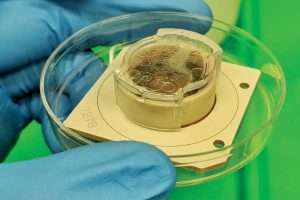
What do you get if you mix brain cells with silicon chips? A type of computer perfect for testing medications and new ideas
Pong might not be the most challenging computer game compared with Grand Theft Auto. But for a tiny clump of 800,000 nerve cells connected toa computer known as DishBrain, playing this classic game represents a giant leap forward in tech.
Cortical Labs, a Melbourne-based research company, has since fine-tuned their method of connecting lab-grown brain cells (called neuronal networks) with silicon chips. Their latest upgrade? CL1. These devices can be rented or even purchased
for research.
By relying on the unique way brain cells compute info, biological computers like these provide researchers with a tool to interact directly with brain-like cells and structures. They can use it to test theories in neurology, computation or experiment
with new medications.
Ethics is a big part of Cortical Labs’ work. Brain organoids aren’t conscious, but it’s still important to consider the consequences. As company co-founder Brett Kagan told AIX Global Media: “We’ll continue to work on it because it’s the right thing to do.”
That means biological computers will open up a whole bunch of interesting career opportunities, from cognitive science and neural engineering to bioethics!
Australia’s home of quantum biotech
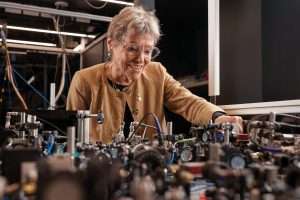
What do you get when you mix quantum physics with biotech? A world-first research centre based in Brisbane
Quantum mechanics is often described as the science of tiny things. But don’t let that fool you – it’s making big waves in health!
Researchers at the Australian Research Council Centre of Excellence in Quantum Biotechnology (QUBIC) in Brisbane are teaming up to solve some of the biggest challenges in biotech and beyond.
“We are working on portable brain imagers based on quantum processes, as well as on single protein sensors working on very short time scales and quantum-enhanced imaging methods,” says QUBIC physicist Professor Halina Rubinsztein-Dunlop. “This will enable super resolution capabilities and help unravel burning problems in many areas of society.”
QUBIC is all about collaboration. Think: quantum physicists chatting with biologists, chemists, neuroscientists, medical practitioners and social scientists.
“The centre offers a wide range of opportunities for emerging physics students, such as deep knowledge of the newest basic principles of quantum science and tech, and their applications into multiple parts of our society,” Halina says.
Start your career here
Technology+health+study
- Bachelor of Health Sciences, The University of Queensland
- Master of Applied Science (Health & Medical Physics), RMIT
- Bachelor of Medical Radiation Science, Charles Sturt University
- Bachelor of Medical Radiation Science (Medical Imaging), University of South Australia
Technology+health+jobs
- MRI technologist: $77K–$127K
- Cardiac sonographer: $79K–$129K
- Data analyst: $59K–$111K
- Geneticist: $90K–$120K
Salaries according to payscale.com
This originally appeared in Careers with STEM: Technology 2025.