Meet 4 ANSTO researchers who know that small science can lead to seriously big breakthroughs
#1 Mining for tech
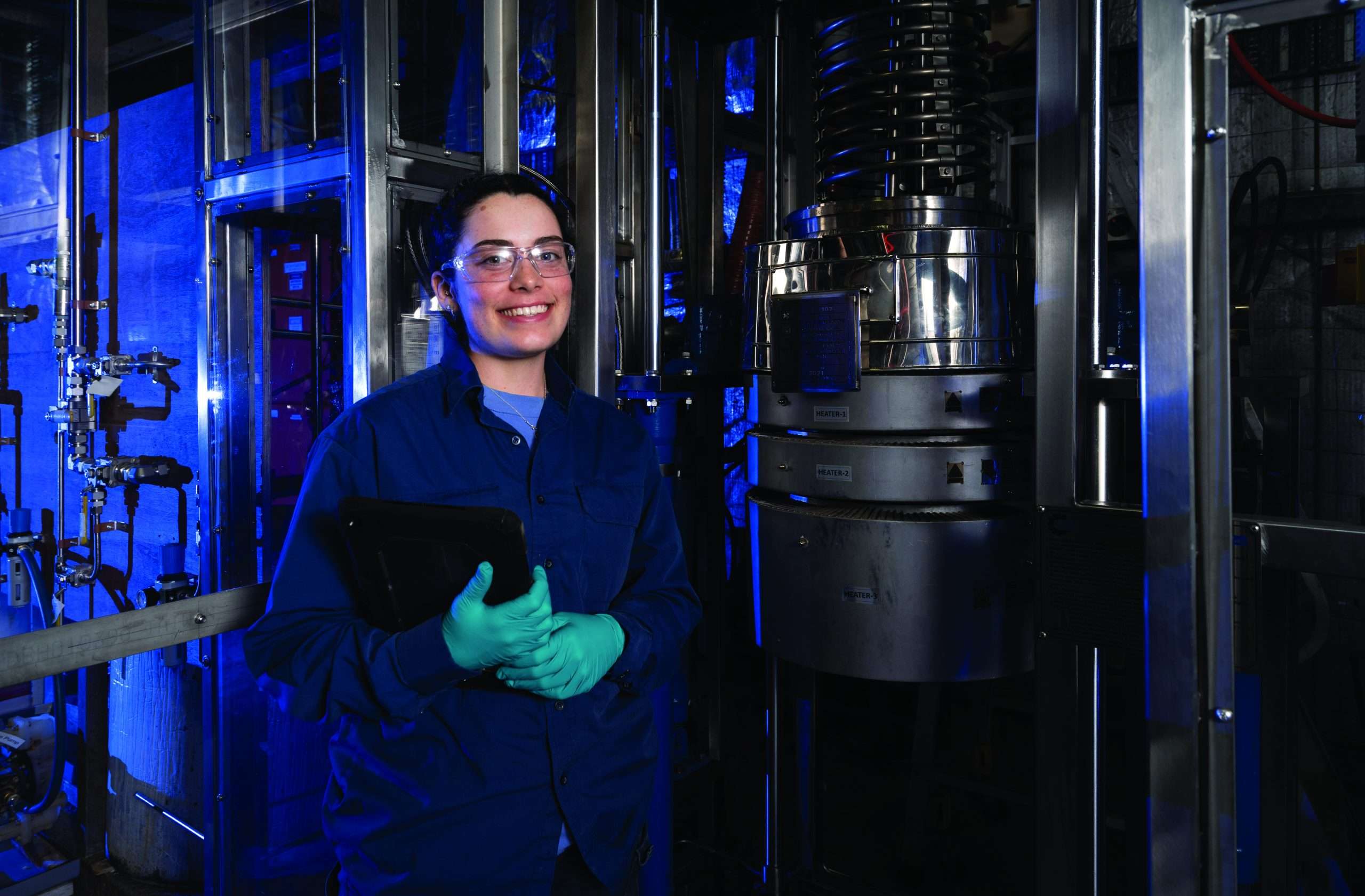
Today, engineers like Charlie are helping mining and mineral processing companies to extract and refine critical minerals for tomorrow’s tech.
Lithium, which is a core component in the most powerful batteries, is used in everything from phones to EVs. It is super important – as are rare earth elements.
“Pretty much all modern technology has some sort of rare earth element in it, from medical devices to wind turbines,” Charlie says. As a process engineer at ANSTO, Charlie works with companies on new ways of refining minerals into pure materials.
“We design a plant that will run at a small or pilot scale and give them data, and then that will be the basis of how their big plant will run,” she says.
Charlie’s tip
“Find a good mentor who you admire, and find people who are supportive of you.”
Charlie’s pathway
- Bachelor of Chemical Engineering (Honours) / Bachelor of Commerce (Finance), UNSW
- Summer vacation student, Santos
- Year in industry student, ANSTO Minerals
- Process engineer, ANSTO minerals
#2 Crystal discoveries

How do we know that DNA is a double helix, or that the COVID-19 virus is covered in spike proteins? The answer is to pummel it with X-rays (or, more formally, a technique called X-ray crystallography).
“You take thousands and thousands of teeny tiny little crystals, way too small to be picked up by hand, and essentially fire them through an X-ray beam, taking shots of them as they go,” explains Rosemary.
As a beamline scientist at the Australian Synchrotron in Melbourne, Rosemary is using crystallography to collaborate with scientists working in drug discovery, batteries and solar cells.
Rosemary’s tip
“It’s hard to know what you don’t know, especially in regional areas, so take all the opportunities that are available to you.”
Rosemary’s pathway
- Bachelor of Science (Advanced) (Chemistry), University of Adelaide
- Laboratory technician, Treasury Wine Estates
- PhD in chemistry, University of Nottingham, England
- Postdoctoral researcher, Monash University
- Crystallography beamline scientist, ANSTO
#3 Super structures
All living things run on proteins: big, blobby molecules with thousands of atoms, performing mysterious duties at the atomic scale.
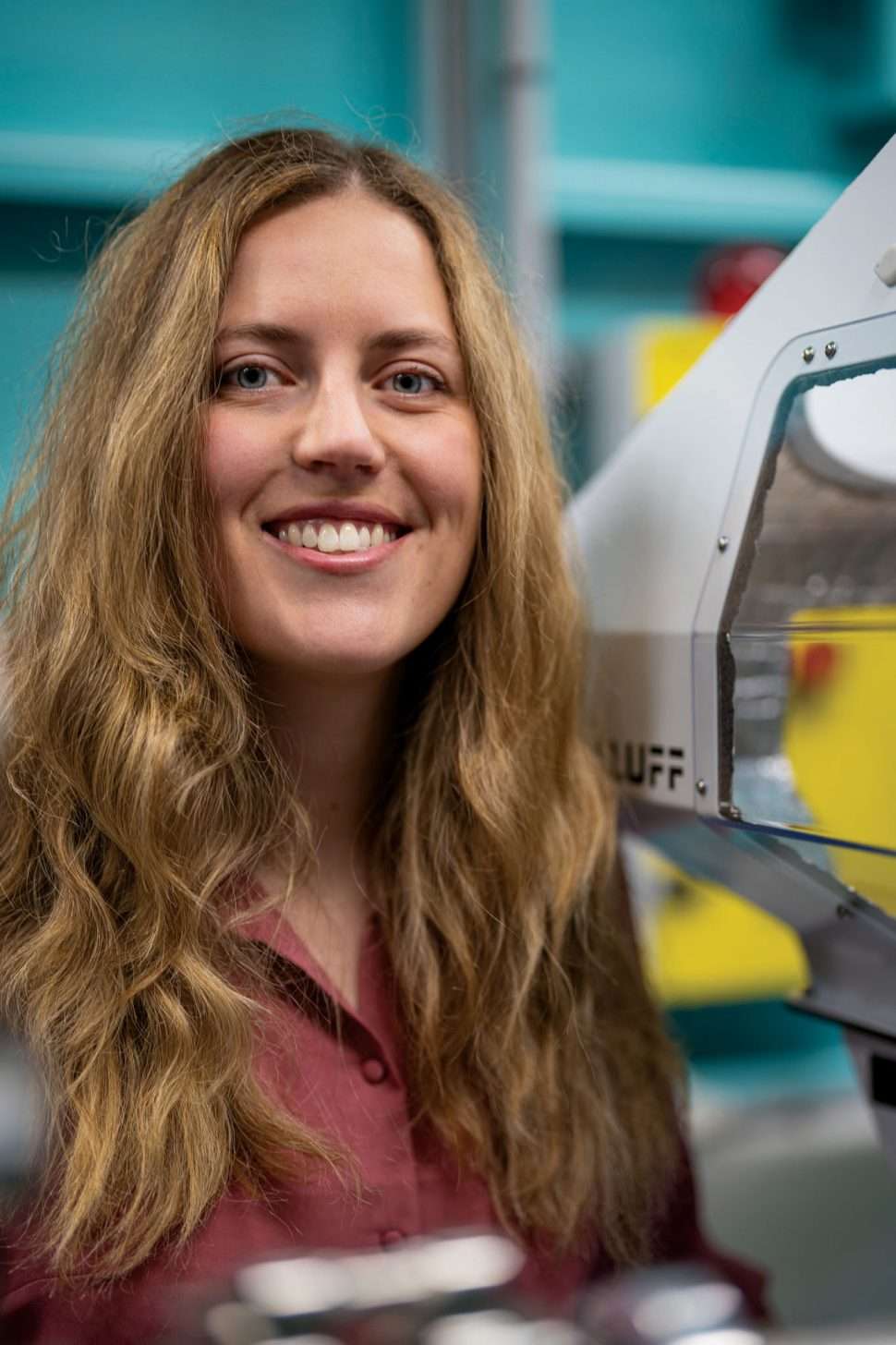
The way we learn more about those duties is by figuring out the shapes of these proteins. At the Synchrotron’s BioSAXS beamline, Annmaree works with researchers to do just that.
“We can use X-rays to understand what structures they’re forming,” she says. “People can understand what they look like, and then maybe design therapeutic drugs to target them, or understand processes in the body.”
Protein structure is important for researchers developing new medicines, but it can also be used to understand non-human proteins – even things like plant evolution!
Annmaree’s tip
“Be confident in what you know, and you’ll pick up on the other things as you go through. It’s okay to not know everything.”
Annmaree’s pathway
- Bachelor of Science (Biochemistry), University of Waikato, New Zealand
- Master of Science (Biochemistry and Molecular Biology), University of Waikato
- PhD in biochemistry, University of Waikato
- Beamline scientist BioSAXS, ANSTO
#4 Bright quantum future
What’s the tiniest thing you can imagine? Bet it’s not as small as what Evan’s been working on. As a beamline scientist at the Synchrotron, Evan is investigating things at the nanoscale, in the order of about a billionth of a metre.
He uses a nanoprobe, which focuses X-ray light on a minuscule spot. “That allows us to be really precise with where we’re applying the light,” he says.
This can help to understand biological cells for medical research, and minerals for mining. But Evan is interested in quantum computing, a sector he says Australia has invested heavily in recently.
Quantum computers are still developing, but as they scale up, the tiny components inside them will need to be analysed at the nanometre level to make sure they work properly. Evan’s tool acts almost like a quality check for the quantum future.

How tiny is a nanometre (NM)?
- Human hair ~40,000 nm thick
- Red blood cell ~7000 nm across
- Bacterium 1000–10,000 nm
- DNA molecule ~2 nm wide
- Most atoms 0.1–0.2 nm
Evan’s tip
“Don’t be afraid to ask questions.”
Evan’s pathway
- Bachelor of Science (Physics) (Advanced Honours), University of Wollongong
- PhD in physics, University of Wollongong
- Postdoctoral researcher, Institut NÉel CNRS, France
- Senior scientist, Technische UniversitÄt Wien, Austria
- Nanoprobe beamline scientist, ANSTO
This article first appeared in Careers with STEM: Science 2026. This article was produced in partnership with ANSTO.