From ancient ideas to modern technology, maths shapes how we understand the world and imagine what comes next
“Maths is one of humanity’s oldest languages – born from the need to count, measure and navigate – and it still underpins how we understand the world today. What I find especially powerful about maths is that it belongs to all of us.
The story of maths is written across cultures and centuries: in ancient systems of counting and measurement, in geometry developed for land, building and astronomy. It’s in the great mathematical traditions of India, China, the Middle East, Mesoamerica and beyond. It’s also woven through the knowledge systems of Aboriginal and Torres Strait Islander peoples, in patterns of navigation, observation and relationships to Country. Too many young people step away from maths early or are made to feel that maths is only for a select few. It is not.
Maths is not about being the fastest in the room or never getting stuck. It’s about curiosity, persistence and learning to think clearly through complexity. If you enjoy patterns, puzzles, logic or asking why things behave the way they do, then maths may be one of the most empowering subjects you
could study.
Maths underpins climate modelling, medicine, finance, cryptography, AI and data-driven decision-making across almost every sector.
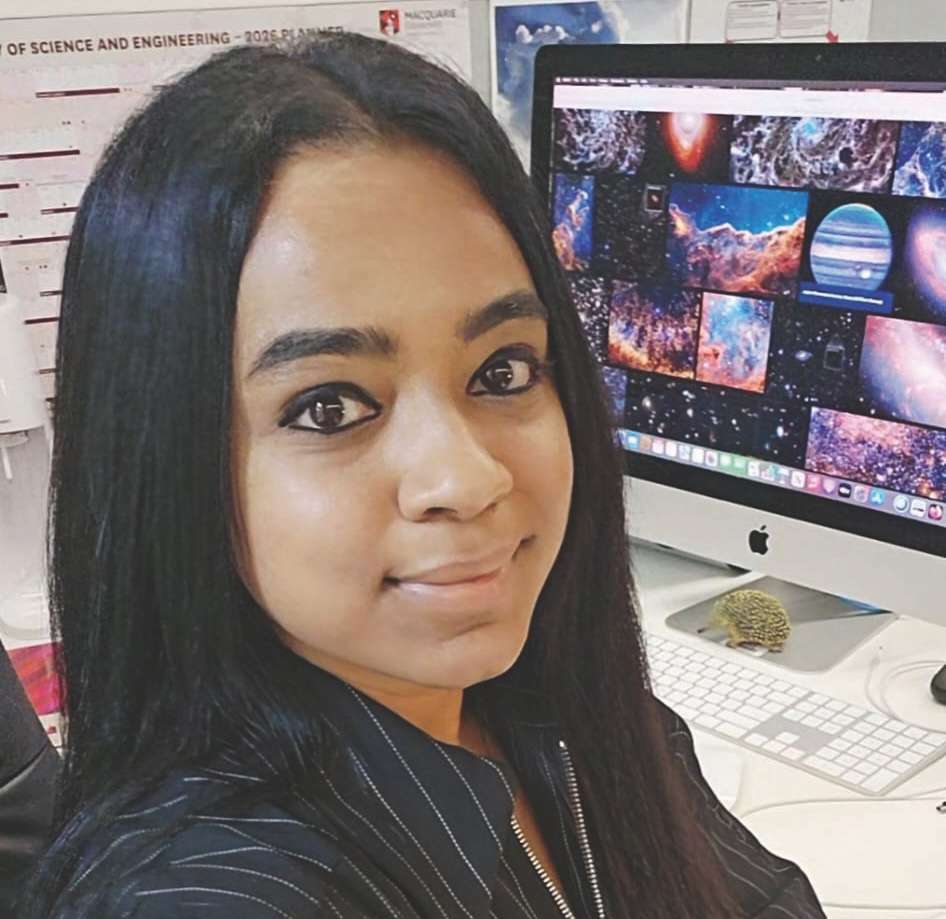
As an astronomer, I use maths to explore the universe – to interpret light from distant stars, trace the dynamics of galaxies an understand phenomena far beyond our physical reach. Yet the same language also shapes the world we live in.
Mathematical training opens doors to diverse futures, including roles that do not yet exist. It builds resilience, adaptability, and confidence – qualities that matter far beyond the classroom.
At Macquarie University, maths sits alongside physics, astronomy and statistics – a reminder that the big questions of our time do not respect disciplinary boundaries.
The world is becoming more complex, not less. Maths gives us a way to navigate that complexity with confidence, imagination and purpose.”
Devika’s pathway
- Bachelor of Applied Sciences (Mathematics, Physics, Chemistry), PSG College of Technology, India
- PhD in astronomy and astrophysics, Australian National University
- Post-doctoral research fellow, KU Leuven, Belgium
- Senior lecturer in astronomy and astrophysics, Macquarie University
- Director of Engagement, School of Mathematical and Physical Sciences, Macquarie University
- Head of School, Mathematical and Physical Sciences, Macquarie University
This article was first published in Careers with STEM: Maths 2026.
Read more:
- 5 careers in mathematics that might surprise you
- What’s it like to be a maths undergrad?
- Meet a mathematics professor