Australia’s space sector is taking off, and there are loads of ways you could be a part of it
With the space industry predicted to triple in size over the coming decade here in Australia, space-related careers are on the up! Lookout for these out-of-the-box next-gen roles. Astronaut not included…
A is for astrophysicist
Applies the laws of physics and chemistry to explain what’s going on with the solar system.
B is for business manager
Keeps up with the science world to create lucrative opportunities.
C is for cyber security specialist
Typically earth-bound, implementing security measures to protect important computer systems.
D is for data scientist
Uses analytics to look for business opportunities, track climate change insights or streamline processes!
E is for electrician
Same deal as on earth – but in space. Construct, install and repair electrical systems in spacecraft and satellites.
F is for fabricator
The tradies of the galaxies! Fabricate, fit, assemble and weld equipment used in spacecraft, satellites and ground stations.

G is for game developer
Programs interactive systems that can be used in training! Think: Virtual Reality (VR).
H is for health and safety officer
Ensures compliance with health and safety systems… for space-related stuffs.
I is for instrumentation engineer
Specialise in the design and development of unique spacecraft instruments, like circuit boards, and sensors!
J is for journalist
Technical journalists present complex info in a way the public can understand.
K is for kinesiologist
Creates fitness plans for astronauts that consider insane things like microgravity!
L is for lawyer
Space lawyers provide advice and prep legal docs to ensure compliance with international space laws and treaties.
M is for mechanical technician
Installing machinery, parts and equipment onto space aircraft.
N is for network administrator
Configuration, installation and maintenance
of computer systems – with co-workers who are literally out in space!
O is for optical engineer
Develop different optics that would be used in a spacecraft or satellites, sensing X-rays to infrared rays.
P is for propulsion engineer
Test and manufacture spacecraft propulsion systems (AKA the science that makes them move).
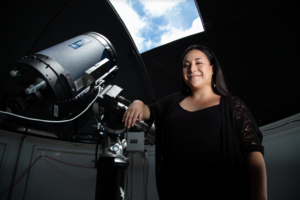
Q is for quality assurance specialist
Examines materials, products, equipment, and other devices for any type of defects or irregularities. Eye for detail = essential!
R is for robotics engineer
Build and operate robots, robotic devices and systems used in anything space-related.
S is for space flight controller
A walking, talking comms channel between the crew, flight director and various specialists.
T is for test technician
Testing is a huge deal in aerospace engineering. Everything from equipment, vehicles, machinery and even workflow processes are trialed, again and again.
U is for undergrad space science student
Not technically employed yet – but they’re on their way to landing an awesome next-gen role!
V is for vehicle engineer
Designs and tests brake systems, engines, fuel tech and transmissions on spacecraft, robotics and rockets.
W is for weather analyst
Monitor sunspots and solar flares to provide impacts to power grids and satellite operators, as well as emergency response comms on earth.
X is for (e)xtreme high-altitude jumper
Supersonic free-falling essentially means jumping from space! Qualifications? Craziness!
Y is for YouTuber
Got science smarts and love sharing your knowledge? Carve a career in space + socials.
Z is for zzzzz
This is the space gig you’ve been dreaming of! Chances are if you kickstart the right study path you can totally get there.
Meet STEM space stars
Vanessa Zepeda, PhD student, QUT : “My journey as an undergraduate exposed me to all the sciences and my love for biology grew from life on Earth to the possible existence of life in the cosmos,” she says.
Professor Phil Bland, planetary scientist, Curtin University: “I hope that Australia engages with the science of space exploration in the way that other nations do. Those nations fly challenging missions because it benefits their space industry sectors in multiple ways. It’s jobs and growth via science.”
James Bevington, astrobiologist, UNSW: “Science is done with different labs across the world, reproducing each other’s experiments and adding knowledge incrementally. I’m trying to make planetary exploration a bit more like that, so anybody can send a mission to Mars.”
This article originally appears in Careers with STEM: Space 2022 – the flip cover to Careers with STEM: Science 2022.
To keep up to date with all things space and STEM careers, subscribe to our weekly e-newsletter!
READ MORE:
- Meet 15 women smashing stereotypes in nuclear science
- How to launch your space career
- 5 jobs you could land with a space science degree
- Download our FREE Space and Defence Specialist Job Kit