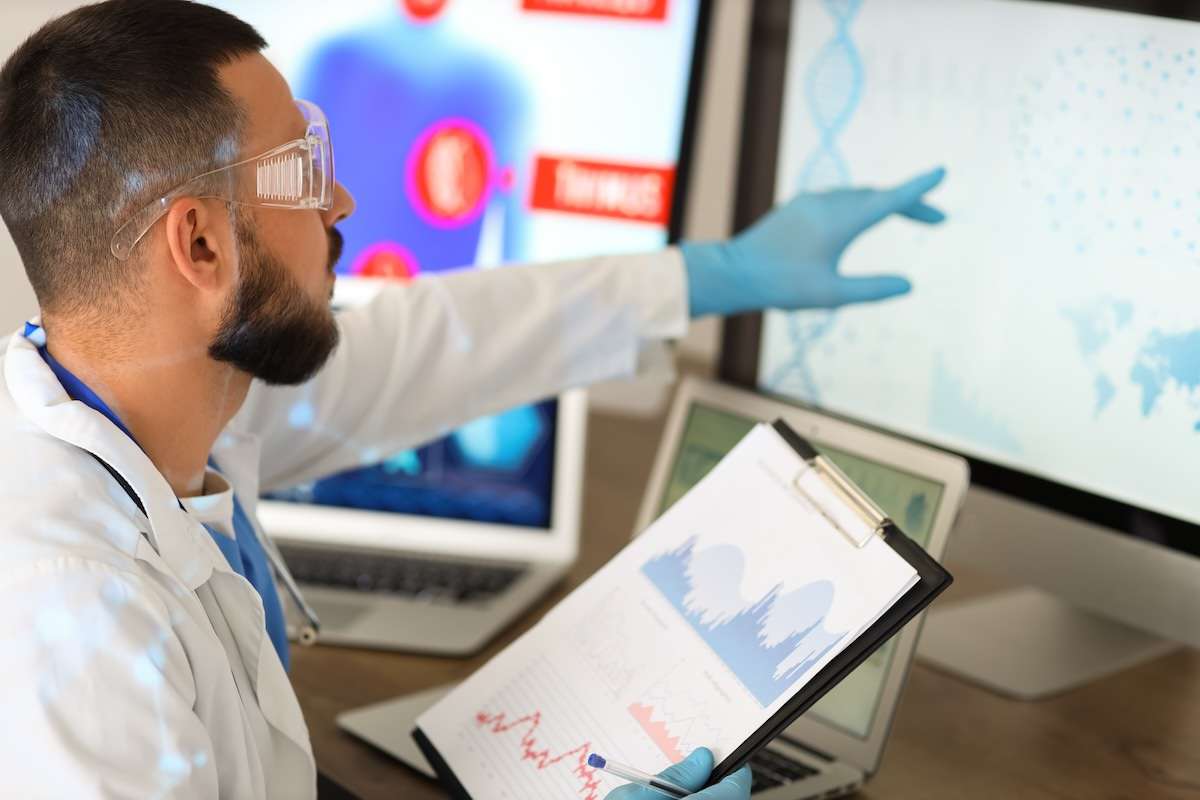
To succeed in science today, you need to be confident in handling large data sets. At Adelaide University, you’ll learn to make meaning from data
Every scientific breakthrough starts with a question, and data is how we find the answer. As the challenges we ask science to solve have become more complex, so has the data collected.
Genetic diseases are treated by sifting through billions of codes in DNA, weather predictions rely on thousands of monitoring stations, and telescopes collect multiple terabytes of imagery and measurements every night – or even every second!
All of this generates more data than a person could ever manage manually. The real challenge isn’t collecting data, it’s knowing how to use it.
With a science degree at Adelaide University, you’re guaranteed to learn this. Every course has built-in data science skills. You’ll study real-world datasets and dissect them to discover the answers, you’ll learn to use high-power data processing programs like R, and you’ll become highly skilled in statistical thinking and data analysis.
Statistics can feel overwhelming, but at Adelaide University, you will be supported to feel confident!
Touching base(s)
A typical person’s DNA contains about 3 billion base pairs. The GenBank database, which collects DNA information around the world, has more than 30,000 billion base pairs in its archives.
Model data
How do we know one region will get warmer, or another will get more rain, as the climate changes? Detailed data-fuelled climate models, which run on computers that can make a quadrillion calculations per second.
Want to dive deeper into data?
Consider a Bachelor of Mathematics with majors in Data Science, Statistics, Applied Mathematics or Pure Mathematics.

Varidhi Shrivastava – Master of Data Science
“If you think carefully, you’ll find that we make data-driven decisions in our everyday lives all the time. It amused me how beneficial data science could be for literally any field of work or research. Data science is far more accessible than it looks. I’ve seen my peers of non-technical and non-mathematical backgrounds do really well in this course!”
This article first appeared in the Careers with STEM: Study Science at Adelaide University