Technology is changing rapidly – creating an opportunity to change how it’s taught
AI is shaking things up in almost every industry. This has created new opportunities and challenges for not only those developing it, but for those using it in their line of work to solve real-world problems.
At Monash University, this disruption became the catalyst for rethinking how an IT education is designed and delivered.
“It’s a chance to be innovative and to try new things,” says Andrew Cain, Director of Education Quality & Innovation in the Faculty of Information Technology, who spearheaded the reimagining of its courses.
Technical skills, like knowing particular programming languages, are important. But these required skills are very likely to change over the course of your career: IT professionals now are not using the same tools they did 10 years ago.
So what does a modern IT graduate need to thrive?
According to Charlotte Pierce, a senior lecturer in the Faculty of IT and co-designer of its education transformation, two of the most important skills are knowing how to learn, and knowing how to collaborate.
“You’re going to learn how to solve problems and how to work with other people. Very few people ever work alone,” Charlotte says.
Andrew and Charlotte’s human-centred, AI-enabled model of learning has been nominated for a UNESCO ICT in Education prize for their work.
So what’s involved in a modern IT degree?
Work experience like you’ve not experienced before
Industry experience is one of the centrepieces of IT education at Monash, but it’s not your typical work placement. Instead, in the second and third years of their degrees, every student will spend a portion of their time working at a student-led company based at the university through professional practice units.
These companies could make things like video games, digital health tools, or renewable energy management systems.
“Whatever the students want to work on – if we think it’s an exciting big project, then we’re connected with that,” Andrew says.
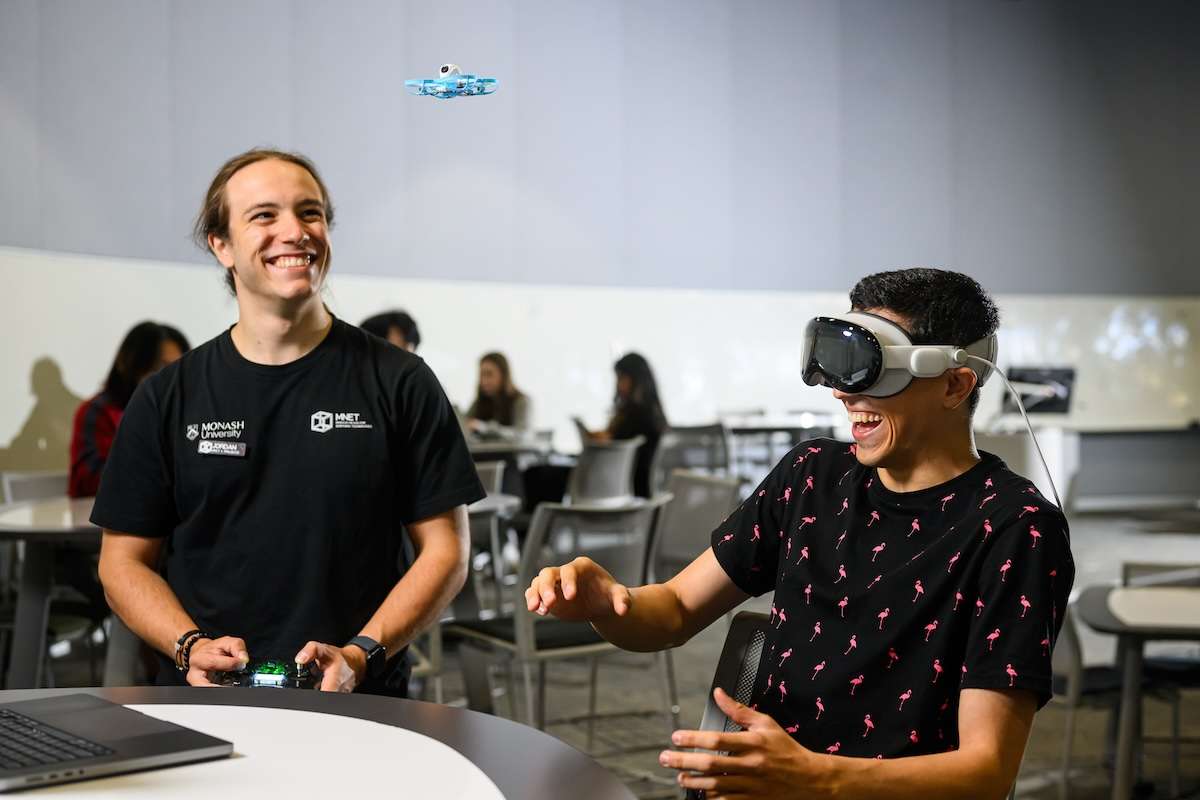
As well as completing and maintaining projects, students will make operational and management decisions at the companies, including interviewing and hiring their peers. There will be plenty of support from academics and industry mentors, but students will be the driving force behind each organisation.
“These companies need to be bold and ambitious,” Andrew says.
In the end, students will graduate with a portfolio of tangible projects and experience that shows their capabilities in action to prospective employers.
“We wanted to help bridge the gap between the end of university and employment. And there’s lots of different ways people do that, but we wanted it to be a more strategic and embedded fashion,” Andrew says.
Making a mark: new ways of assessment
Another key part is the change in the way work is assessed. Instead of traditional assessments, the degree is moving to a portfolio-based assessment model with fewer strictly marked assignments and tests.
“Once you don’t have the idea of marks, you can be much more creative in the way assessment works,” Andrew says.
The professional practice units will support this: instead of being judged on final assignments, students will be showing what they’ve learned and how they’ve dealt with problems and failures along the way.
“Failure is not bad. It’s great. It’s how you learn. It’s how projects progress,” Charlotte says.
These features, combined with flexible pathways, interdisciplinary opportunities, Industry-based Learning (IBL) and IT Student Teams, are going to help prepare the next generation of IT professionals.
“It’s much more about the journey, and we’ve actually built that into the assessment itself,” says Charlotte.
This article was brought to you in partnership with the Monash University Faculty of IT.
Read more:
- Don’t choose between tech and your passion, at Monash you can have it all!
- Be part of the digital revolution as a master in technology
- Ctrl+Alt+Include: Assistive tech
Images: Monash University Faculty of IT