With thousands of Australians travelling this Easter, there’s a huge need for STEM employees in the aviation industry
As jet-setting Australians return to their pre-pandemic holiday habits, research out of the Bureau of Infrastructure and Transport Research Economics shows almost 11 million passengers took to the skies in August alone.
Demand is high for workers across all aspects of air travel, including loads of STEM roles – operational flying, technical support, ground and cabin crew, border control and security services. But the biggest booming area? Jobs for aircraft maintenance engineers, projected to increase by 17% by 2026.
TAFE NSW Aeroskills Teacher David Duncan said in his time working in the aviation industry, he has never seen such a high demand for skilled aviation workers.
“Employers are screaming out for staff right now – there is an incredible resurgence taking place in the aviation sector so there are job opportunities galore,” Mr Duncan said.
“If you have a curious mind and love working with your hands, aircraft engineering is a fascinating and versatile profession. We see graduates working on helicopters, light planes and larger aircraft all over the world.”
And with uni no longer the only option, getting qualified is often fast-tracked via TAFE and VET study.
“Our hands-on, practical courses at TAFE NSW ensure students can graduate on Friday and walk into an airport or hangar with all the skills to start work on Monday.”
Female engineers wanted
NSW employs the largest proportion of aircraft maintenance engineers across the country, but only 3% of those are women.
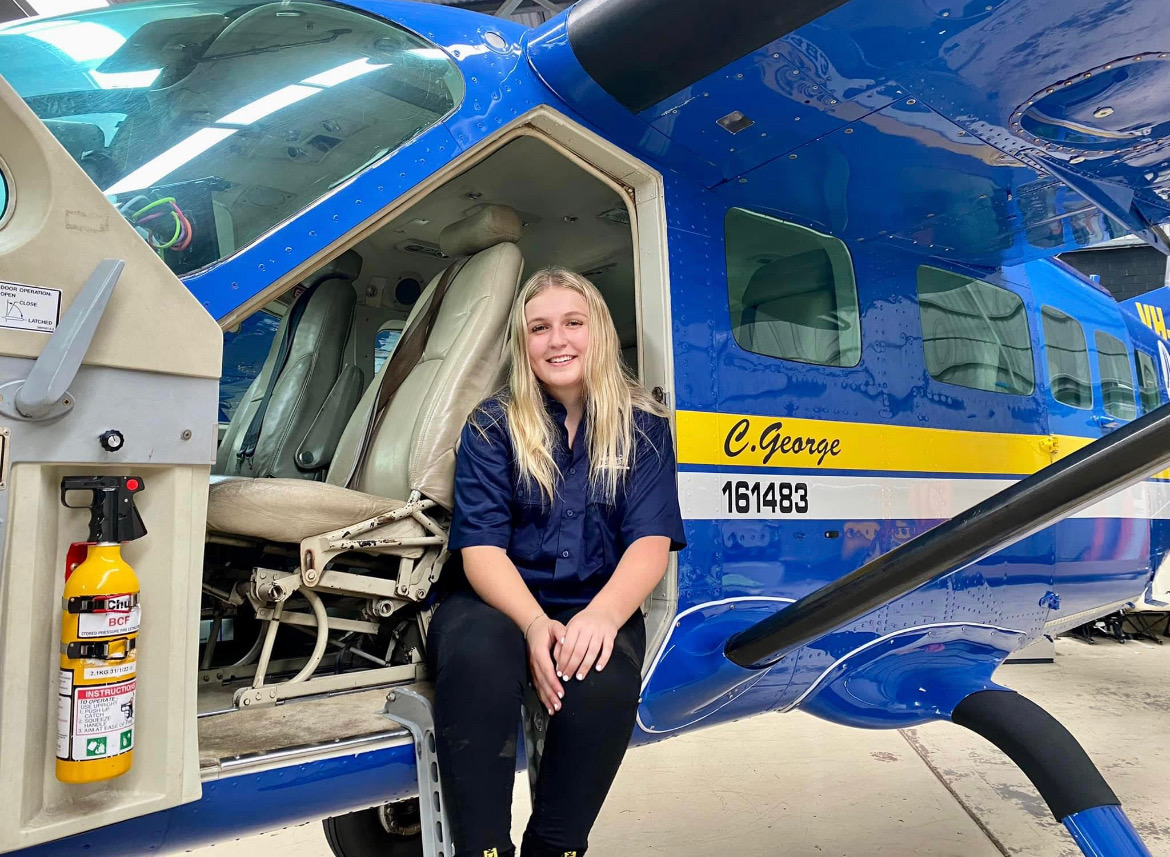
Lara Oyston is an 18-year-old Dapto local who has scored her dream job in the industry as an apprentice aircraft maintenance technician with Sky Dive Australia.
Having always been drawn to a trade, Lara discovered the Certificate IV in Avionics at TAFE NSW Padstow, where she has found the practical skills have supported her on the job.
“I’m a first-year apprentice, so some days at work can be pretty overwhelming. Having the time to sit down and study things like aircraft parts or safety regulations in depth has been incredibly valuable,” Ms Oyston said.
“At work I focus on Cessna planes, but at TAFE I get to broaden my skills by working on a variety of aircraft I wouldn’t normally have access to.”
“I’m so grateful to have industry experts on tap to ask questions; the support from teachers and the skills I have gained have all helped me so much.
VET pathways into aviation
Keen on heading into aviation via a non-uni route like Lara? Below are two examples of STEM professionals flying high with their VET qualifications.
Christian Ferrone, aircraft maintenance engineer
When Christian found out he was colourblind more than halfway through his flying degree, his lifelong dream of becoming a pilot crash-landed. “I felt pretty disheartened,” he says. Christian worked in construction for a few years, but couldn’t shake his passion for aviation.
He did a pre-apprenticeship course in aircraft mechanics, and has been flying high ever since. Christian is now working as an aircraft maintenance engineer. His achievements were recognised as the Western Australian Apprentice of the Year and an Australian Apprentice of the Year finalist at the Australian Training Awards in 2021.
Read Christian’s full pathway here.
Philip Brown, aviation engineer
Philip Brown completed a four-year apprenticeship, including a Certificate 4 in Aeroskills, at Padstow TAFE in NSW. And now? He’s a Field Service Technician at Safran Helicopter Engines based at Bankstown Airport.
“We need more people, especially women, in aviation engineering, ” he says. “It’s important to remember there is light at the end of the tunnel. When studying engineering or completing an apprenticeship, four years may seem like forever, but it passes very quickly.”
Read Philip’s full pathway here.
READ MORE: